


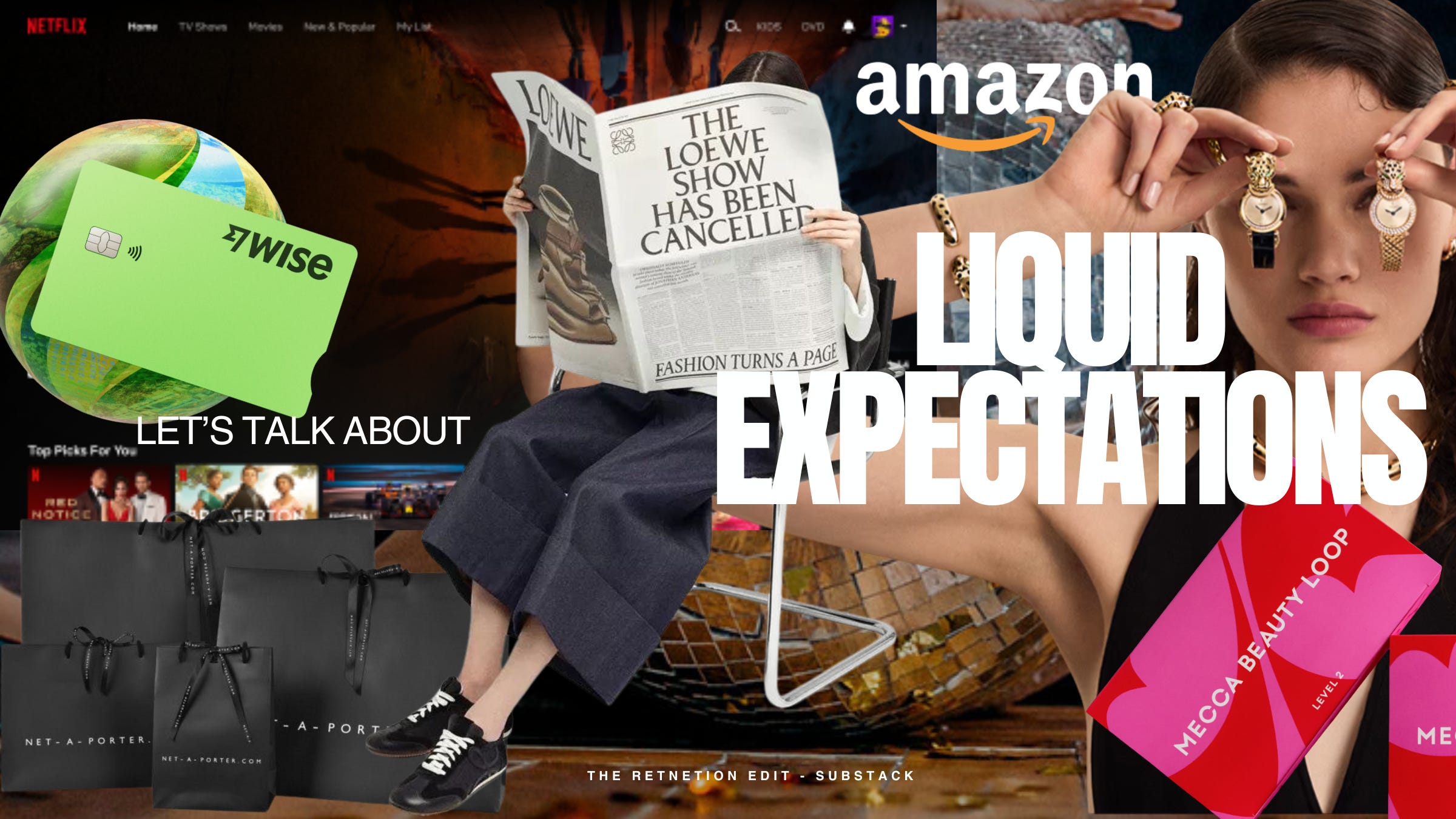
Five years ago, my colleagues at Ogilvy Paris introduced me to the term ‘liquid expectations’ — the idea that customers measure your brand against the best experiences they’ve had anywhere, not just your direct competitors. It’s still the most powerful insight I share in CX projects I lead — and it never fails to get that ‘oh wow’ reaction from clients.
I guess there’s a quiet arrogance in brand and marketing— the belief that your customer is only comparing you to others in your category. That if you’re a beauty brand, you're being compared to other beauty brands. If you’re an airline, it’s just you and the other carriers.
Wrong.
Today’s customer expectations are shaped by every brand they interact with. The brands that win hearts and minds — and wallets — are setting the standard for all categories.
Amazon made customers expect the same or next-day delivery as the norm — so now anything slower feels like an inconvenience.
Apple made them expect beautiful, intuitive UX with Apple Pay — so now clunky checkout flows feel lazy, annoying and eye-roll evoking.
Net-a-Porter made them expect packaging that feels like a gift — so when your product arrives in a scrunched plastic bag, it feels cheap, no matter the price tag.
Mecca made them expect hyper-personalisation — such as perfectly timed ‘refill your empties’ emails, so when you send a generic email blast, they tune out.
Uber made them expect real-time transparency — from knowing their driver's name to watching their meal move live on a map — so vague shipping updates don’t cut it anymore.
Loewe made them expect creativity at every touchpoint — from window displays to packaging to product storytelling, — so your templated seasonal campaign feels uninspired by comparison.
These are liquid expectations. They seep across categories. What customers experience in one industry reshapes what they demand in another — and it happens unconsciously. They’re not thinking, “Why doesn’t my insurance app work like Netflix?” But they are feeling it every time it doesn’t.
What this means for your brand
You are no longer just competing within your vertical. You're competing against the last best experience your customer had — with any brand.
That means:
Your shipping updates are judged against Uber’s live map and ETAs.
Your loyalty program is judged against Sephora’s community.
Your payment flow is judged against Apple Pay’s one-tap checkout.
Your app interface is judged against Apple’s fluid UX.
Your emails are judged against Mecca’s timely, personalised comms.
Why most brands miss this.
They benchmark against outdated competitors, run “voice of customer” surveys in isolation, and measure themselves against what’s expected — not what’s exceptional.
But customers don’t think in segments. They think in standards — and those standards are getting higher every day.
So what do you do?
Reframe your benchmarks. Stop looking sideways at competitors. Start looking at the brands your customers actually engage with — fashion, tech, delivery, banking, entertainment.
Build Customer Mindsets for each segment. Personas capture who your customer is. Mindsets capture how they think and behave in different moments. They’re the “double click” of personas — sharper, more dynamic, and built around motivations, attitudes, and expectations. For example: the Efficiency Mindset expects speed and zero friction (think Amazon, Uber). The Indulgence Mindset expects beauty, theatre, and surprise (think Loewe, Net-a-Porter). Mapping these across your segments shows you which cross-category brands are shaping the standards you need to meet.
Raise the bar on basics. Fast delivery, clear comms, beautiful design, zero friction. These are no longer “nice to haves” — they’re entry tickets.
Connect across channels. If your app, email, and store feel like different planets, you’ve already lost.
Think human, not channel. Customers don’t care about “touchpoints.” They care about time, effort, emotions, and life moments.
What platforms & tools to use in discovery
There’s no handbook on liquid expectations. I’ve built my own approach over time, and these are the tools and steps I use to uncover a client’s cross-category competitors:
STEP ONE: Gather market, psychographic, and demographic data
Start broad. Identify the top-performing brands (local and global) across all categories your audience engages with. This gives you the wider universe beyond direct competitors.
Example: When working on Lululemon’s Membership program, I looked not just at Nike, Alo, and GymShark, but also at Mecca, Sephora, Errone, ClassPass, Barry’s, and Oura — because that’s where the same customers were spending time and money. People that are interested in activewear are also interested in fitness, in healthy food, skincare, wearable tech and so fourth.
STEP TWO: Run a SEMrush Competitor Analysis
With your cross-category brand list in hand, audit their e-commerce and digital marketing performance as a closed group. Compare website traffic, engagement levels, conversion rates, and email/social effectiveness. This reveals who is actually winning attention and driving performance.
STEP THREE: Use the SEMrush Brand Cross-Over Report
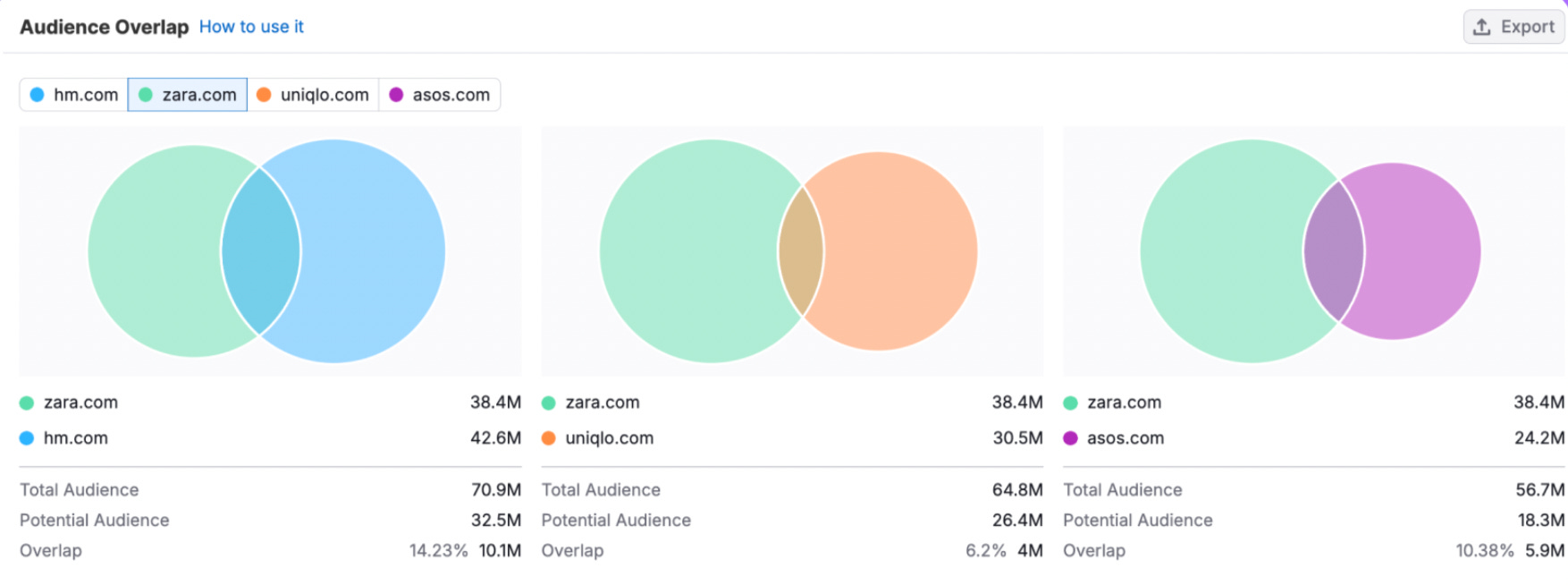
Take your top performers and input them (plus your own brand) into the Brand Overlap report under Trends. This shows the percentage of customers who visit both your brand and these cross-category competitors. The output gives you concrete data on audience crossover - hypothetical examples* - Mecca & lulumeon 16%, Barry’s & Lululemon 10%, Goop & Lululemon 17% etc.
STEP FOUR: Translate insights into liquid expectations
Now that you know where audiences overlap, dig deeper into those brands’ experiences.
Example: In Australia, I found a large crossover between Lululemon and Mecca customers. That meant Mecca — not Lorna Jane — was a more relevant benchmark for experience design.
Food for thought:
If your customer just stepped out of an Apple store, scrolled Loewe on Instagram, tracked their Uber, got same day delivery with Amazon — how does your brand experience hold up?
Because in the world of liquid expectations, everyone is your competitor.
Even Apple. Even Jacquemus. Even Amazon.
* % figures and cross-category brand examples are provided as illustrative hypotheticals. Accurate figures and brand crossover data have been intentionally omitted from this article.
Written by Emily Shum - A CX Strategist based between Paris and Sydney - specialised in loyalty, CRM, content, experience design and business growth. Emily has worked on brands like Lululemon, OMEGA, Coca Cola, IKEA and Michelin agency-side with Ogilvy. Client-side with Hilton and Virgin, and currently she’s with Richemont working on brands like Cartier, Chloe, Piaget and Dunhill.

